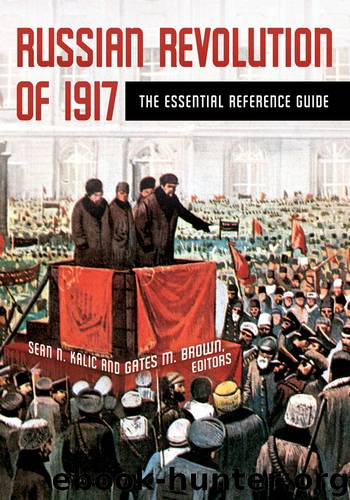
Russian Revolution of 1917: The Essential Reference Guide by Sean N. Kalic Gates M. Brown
Author:Sean N. Kalic,Gates M. Brown
Language: eng
Format: epub
ISBN: 9781440850936
Publisher: ABC-CLIO
Red Guards form a defensive line in Petrograd as the Bolsheviks work to solidify power during the Russian Revolution of 1917. (Keystone/Getty Images)
On July 26, a prolonged government crisis developed following the resignation of Prince Georgy Lvov over anticipated labor and agrarian policies. Kerensky succeeded him as prime minister. Kerensky’s cabinet was moderately Left-oriented, with 12 of the 16 ministers divided between the Socialist Revolutionary Party, the largest political party in Russia, and the Mensheviks, an evolutionary socialist party. Kerensky tried to placate both the Left and the Right, but fearing the Bolsheviks, he ordered recently appointed commander of the armed forces General Lavr Kornilov to prepare to march on Petrograd if the Bolsheviks stirred up an insurrection.
In early September when the German Army occupied Riga and the road to Petrograd lay open, Kornilov sent a cavalry corps toward the capital, ostensibly to protect it. His action was seen as a right-wing attempt to reverse the revolution, however. Sensing the approaching danger, the Petrograd Soviet organized to protect the revolution. The Petrograd garrison and Kronstadt sailors were joined by idle workers, all strongly influenced by Bolshevik calls for peace, land, and bread, were now mobilized to barricade and protect the capital. Kerensky appealed to the Bolsheviks to assist in defending against counterrevolution, released imprisoned leaders such as Leon Trotsky, and armed the Bolsheviks’ Red Guard. Meanwhile, Bolshevik-influenced railroad workers stopped Kornilov’s troops short of the capital, convincing even the most trusting soldiers that they were helping to restore the hated monarchy.
The Bolsheviks, able to claim that they had saved the revolution, now gained 50 percent of the seats in the Petrograd Soviet. In September backed by leftist Social Revolutionaries, Trotsky was elected chairman of the Petrograd Soviet. He immediately withdrew that body’s support from the Provisional Government. When in September the rumor circulated that the government might move the capital to Moscow to protect it from the German Army, the Petrograd Soviet claimed full control of troop deployments in and around Petrograd. On October 14, the Petrograd Soviet appointed a Military Revolutionary Committee. Ostensibly it was to defend the capital; however, its members became the General Staff of the Bolshevik Revolution.
Lenin had slipped back into Petrograd, and although many leading Bolsheviks balked at his suggestion that the time was ripe for an armed uprising, on October 17 in a secret meeting the Central Committee of the party voted narrowly in favor of an attempt to seize power. The Provisional Government remained passive, although it was vaguely aware of Bolshevik preparations. The non-Bolshevik Executive Committee of the All-Russian Congress of Soviets postponed its meeting until October 26 and ordered a halt to all demonstrations and the issuance of arms without the committee’s approval.
On October 24, the Bolsheviks sent regiments under their control to occupy strategic sites around the capital. On the evening of October 25, the Provisional Government announced a state of emergency and declared the Petrograd Soviet’s Military Revolutionary Committee, controlled by Trotsky, to be illegal and ordered his arrest along with other Bolshevik leaders, including Lenin.
Download
This site does not store any files on its server. We only index and link to content provided by other sites. Please contact the content providers to delete copyright contents if any and email us, we'll remove relevant links or contents immediately.
| Africa | Americas |
| Arctic & Antarctica | Asia |
| Australia & Oceania | Europe |
| Middle East | Russia |
| United States | World |
| Ancient Civilizations | Military |
| Historical Study & Educational Resources |
Room 212 by Kate Stewart(5121)
The Crown by Robert Lacey(4817)
Endurance: Shackleton's Incredible Voyage by Alfred Lansing(4783)
The Iron Duke by The Iron Duke(4356)
The Rape of Nanking by Iris Chang(4213)
Joan of Arc by Mary Gordon(4110)
Killing England by Bill O'Reilly(4003)
Say Nothing by Patrick Radden Keefe(3986)
I'll Give You the Sun by Jandy Nelson(3447)
Shadow of Night by Deborah Harkness(3368)
Hitler's Monsters by Eric Kurlander(3343)
Mary, Queen of Scots, and the Murder of Lord Darnley by Alison Weir(3210)
Blood and Sand by Alex Von Tunzelmann(3205)
Eleanor & Park by Rainbow Rowell(3175)
Darkest Hour by Anthony McCarten(3133)
Margaret Thatcher: The Autobiography by Thatcher Margaret(3082)
Book of Life by Deborah Harkness(2939)
Red Famine: Stalin's War on Ukraine by Anne Applebaum(2934)
The One Memory of Flora Banks by Emily Barr(2863)
